
You have a website. You show up on Google. You have reviews. But when a homeowner in your city opens ChatGPT and types "who should I call for a burst pipe in Hamilton?" your name is not in the answer.
Someone else's is.
This is not a ranking problem. It is a visibility problem with a different set of rules. The shift is happening faster than most trades owners realize: 45% of consumers now use AI tools to find local services, up from just 6% a year ago. AI-referred traffic to business websites grew 527% year over year. And when researchers examined where ChatGPT actually pulls its local answers from, they found that 58% of ChatGPT Search sources for local queries were business websites. Your website is the raw material for a contractor recommended by ChatGPT. The question is whether yours gives the AI enough to work with.
But here is the hard part: ChatGPT currently recommends just 1.2% of local business locations it evaluates. The rest do not exist in its answers. This post explains what separates that 1.2% from everyone else, and what a trades business owner can do this week to start showing up.
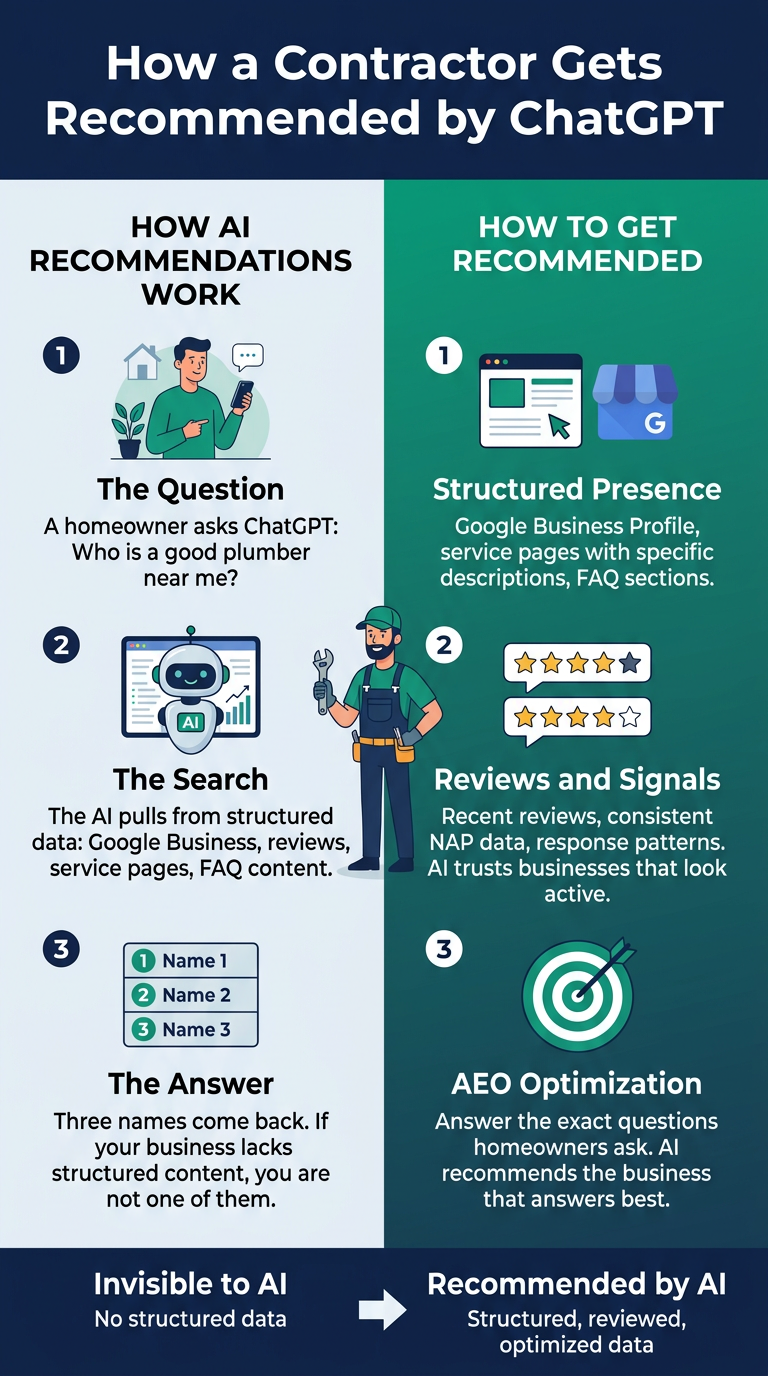
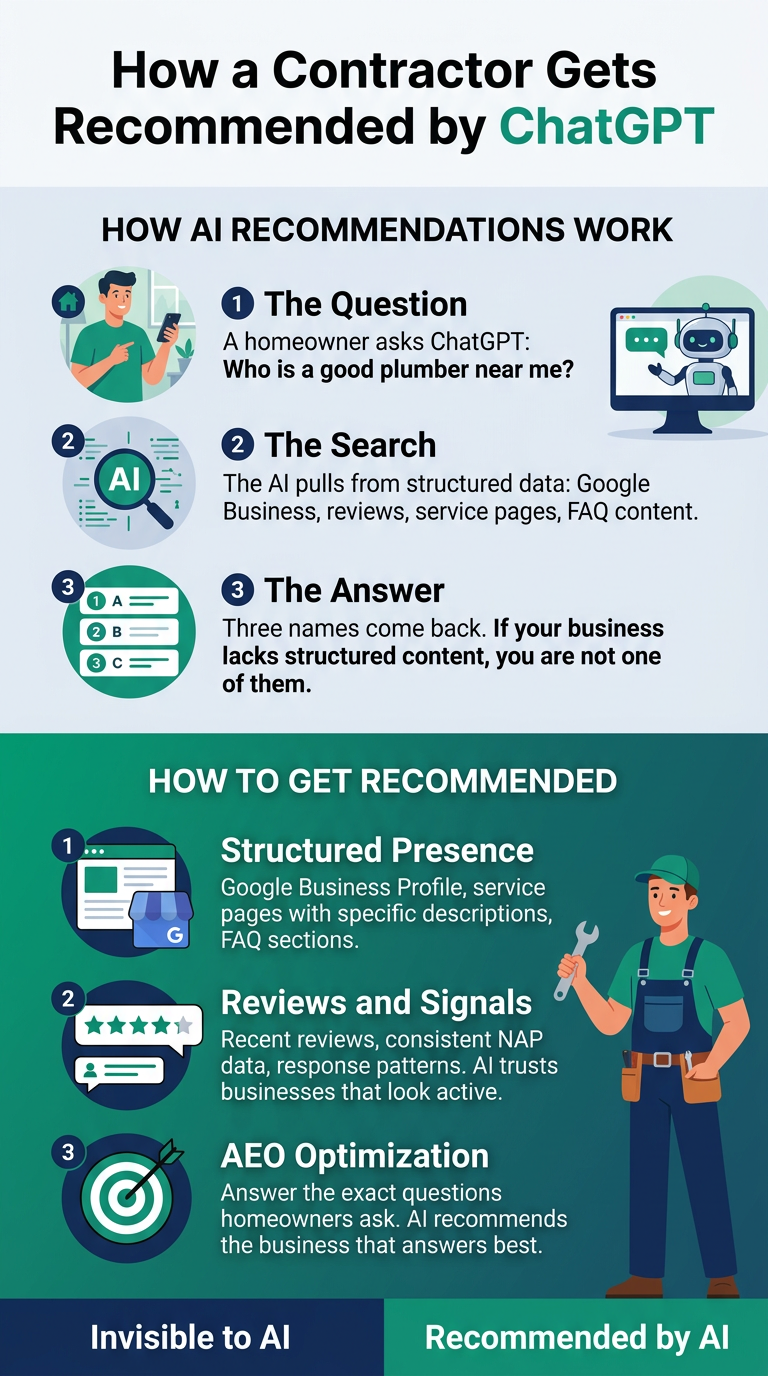
Why Getting Contractor Recommended by ChatGPT Is a Different Problem Than Google
When someone searches Google, they get a list of blue links. They click one, read the page, maybe call you.
When someone asks ChatGPT a question, they get a direct answer. One or two businesses get named. The rest do not exist in that conversation.
Google rewards pages that rank. AI tools reward sources they trust. The difference matters because the criteria are different.
AI tools are trained to pull from sources that give clear, specific, structured answers to real questions. They weight things like business listing completeness, review volume and sentiment, the specificity of your service descriptions, and whether your website answers the actual questions people ask. Research into how ChatGPT builds local recommendations adds another layer: 60 to 70% of local results served by ChatGPT derive from Foursquare location data. That means the directories and listings you appear in are feeding the AI's answers directly, not just your website.
The competition for AI visibility is also tighter than Google: AI-powered local packs now surface only 32% as many unique businesses as traditional map packs, featuring 1 to 2 results instead of 3. A contractor with a thin five-page website and a half-filled Google Business Profile can rank fine on Google through backlinks and age. That same contractor will not get a ChatGPT local business recommendation.
This is what Answer Engine Optimization (AEO) addresses. Google ranking and ChatGPT recommendations are not the same, and the gap between them is growing. I covered the broader concept in the Canadian AEO checklist. What follows is the trades-specific version: what to actually do, in order, starting now.
Step 1: Claim and Complete Your Google Business Profile for AI Visibility
If you do nothing else on this list, do this.
Google Business Profile (GBP) is the single biggest signal AI tools use when generating local recommendations. ChatGPT, Perplexity, and Google AI Overviews all pull from it. An incomplete profile is a visibility ceiling you placed on yourself. Yet only 52% of Canadian small businesses actively use Google Business Profile, according to CFIB research. That means nearly half your local competitors have already handed you an advantage you may not be taking.
What to do: Claim your profile at business.google.com if you have not already. Fill in every field: business name, address, service area (the cities and towns you actually cover), phone number, website, business hours, and holiday hours. Choose your primary category carefully. "Plumber" is better than "Contractor." "HVAC Contractor" is better than "Home Services." Add your services individually with descriptions. Not "plumbing" as a single line. List each: drain cleaning, water heater installation, emergency pipe repair, fixture replacement. Upload photos of your van, crew in action, before and after jobs. AI tools treat photo volume as a proxy for business legitimacy.
Why this matters for Google Business Profile AI visibility specifically: Google AI Overviews pull directly from GBP data to construct local answers. A complete, specific profile gives the AI the structured information it needs to include you in a response. A sparse one gives it nothing to work with.
Step 2: Add FAQ Schema to Your Website
Schema markup is code you add to your website that tells search engines and AI tools exactly what your content means. For trades businesses, FAQ schema is the highest-return application.
Think of it this way: when someone asks ChatGPT "how much does it cost to replace a furnace in Ontario?", ChatGPT is looking for a source that answered that question directly. If your website has a page with that exact question and a clear, useful answer, and the code structure signals it as a FAQ item, you become a candidate for citation.
What to do: Build a FAQ section on each service page. Not a generic FAQ. Service-specific questions that your actual customers ask. For an HVAC page: "How much does furnace replacement cost in Ontario?" and "How long does a furnace installation take?" and "What TSSA certifications should an HVAC contractor have?" Add FAQ schema markup to those sections. If you have a WordPress site, plugins like Yoast or Rank Math do this automatically. If your developer built a custom site, ask them to add it.
You do not need to understand the code. You need to understand that the questions have to be real. Stuff your FAQ with thin answers and the signal is worthless. Give honest, specific answers, and you are doing something most of your competitors have not thought about yet.
Step 3: Get Specific in Your Service Descriptions
"Plumbing services" tells an AI tool nothing. It cannot recommend you for a specific job because it does not know what you actually do.
This applies everywhere your business is described: your website, your GBP listing, your HomeStars profile, your invoices, your email footer.
What to do: Replace generic service names with specific, location-anchored descriptions. Not "plumbing services." Instead: "Emergency pipe burst repair for homeowners in London, Ontario." Not "electrical work." Instead: "Panel upgrades and EV charger installation in the Waterloo Region." Include the province or city in your descriptions. Name the specific problems you solve. "Leaky faucet repair," "sump pump installation before spring flooding," "aluminum wiring remediation." Real problems, not categories.
A roofing contractor in Mississauga who describes their work as "residential and commercial roof replacement, storm damage assessment, and ice dam removal in the GTA" is giving AI tools five specific match points. One who writes "quality roofing services" is giving them zero. AI visibility for home services depends on specificity. Vague descriptions are invisible descriptions.
Step 4: Collect and Respond to Plumber and Electrician ChatGPT Reviews
Review volume, recency, and your response rate all factor into how AI tools evaluate your credibility. This applies to every trade. Plumber, electrician, roofer, HVAC tech. The AI does not care what your specialty is. It cares whether your reviews signal that you are a real, active, trusted business.
Perplexity, in particular, pulls review sentiment when constructing local business recommendations. ChatGPT uses reviews as a trust signal when deciding whether to include a business in an answer. Google AI Overviews use your review star rating as a visible element in local summaries.
What to do: Ask for reviews after every completed job. Text is more effective than email for this. A simple message with a direct link to your Google review page takes ten seconds to send and converts well. Then respond to every review. 88% of consumers say they would use a business that responds to all its reviews, compared to far fewer for businesses that ignore them. Your response is read by AI tools. It is also read by every potential customer who looks you up. Aim for recency. Fifteen reviews from the last three months are more useful to AI tools than 80 old ones. Build a habit, not a one-time push.
Step 5: Create Content That Answers Real Questions
This is where most trades businesses leave money on the table, because they assume content marketing is for consultants and agencies, not electricians.
It is not. It is for anyone who wants to show up in AI search as a contractor worth recommending.
The numbers for home services are striking. ChatGPT generated 83% of all AI-referred leads to home services contractors in Q1 2026. And booked customers from AI leads increased 44% from January to March 2026 in that same period. The traffic is real, it is growing, and it is converting. The question is whether you are showing up when it arrives.
What to do: Write one blog post per month that answers a specific question your customers actually ask. These posts do not need to be long or stylish. They need to be accurate and specific. Good examples: "How much does it cost to replace a hot water tank in Ontario in 2026?" or "What permits do you need for a basement renovation in Toronto?" The post should include the actual answer, not a deflection to "call for a quote." Giving the answer builds trust. It also gives AI tools something to cite. Include your city and province naturally.
I wrote about how this kind of content feeds AI recommendations in the AEO Autopilot post if you want the fuller picture of how the system works together. For the strategic context on the shift from SEO to AEO, that post covers why traditional search optimization is no longer enough on its own.
Step 6: Make Sure Your Website Loads Fast and Works on Mobile
This is table stakes, but it disqualifies a surprising number of trades websites. 22% of Canadian small businesses have no website at all, and among micro-firms with fewer than 5 employees, roughly 30% are completely offline. If you have a working website, you are already ahead of a third of your competition. Make sure it is not holding you back.
AI tools do not recommend sources that are slow to load or broken on mobile. A website that takes six seconds to load on a phone signals unreliability. Google's crawlers, which feed the data AI tools use, penalize slow and unresponsive sites.
What to do: Run your site through Google's PageSpeed Insights (pagespeed.web.dev). It is free and gives you a score and a list of specific fixes. Make sure every page renders properly on a phone screen. Navigation should be tappable. Phone numbers should be clickable. Contact forms should work. If your site is more than five years old and has never been reviewed, budget for a rebuild or a performance audit.
Step 7: Get Listed in Canadian Trade Directories
AI tools build trust by cross-referencing. If your business shows up on HomeStars, Trusted Pros, your provincial trade association's directory, and the Better Business Bureau, that corroboration increases your credibility in the AI's assessment.
What to do: Claim or create your HomeStars profile (homestars.com). HomeStars has over 1.5 million verified Canadian reviews and is the most significant Canadian-specific directory for trades. List with Trusted Pros (trustedpros.ca) if your trade is covered. Join your provincial trade association if you are not already a member. Many have public member directories that AI tools index. Make sure your business name, address, and phone number are identical across every listing. Any inconsistency weakens the corroboration signal.
What This Looks Like in Practice
Mike runs a one-man plumbing company in Guelph, Ontario. He has a website, a Google Business Profile, and about 20 reviews from the last three years. He ranks on page two for "plumber Guelph." Nobody asks him how he does online. He just shows up and does good work.
A homeowner in Guelph asks ChatGPT: "Who should I call for a basement flood in Guelph Ontario?" ChatGPT names two businesses. Mike is not one of them. The two it names have complete GBP profiles, recent reviews, FAQ-rich websites that use specific city names, and listings on HomeStars and Trusted Pros.
There is another piece Mike has not thought about. When the AI does name a competitor and a homeowner calls, response time matters. The median first-response time for home service businesses is 42 minutes, and only 12% respond within 5 minutes. Being recommended is only half the equation. A fast, personalized response is what converts that recommendation into a booked job.
Mike spends three hours updating his GBP profile, adds a "Services" section with twelve specific line items, asks his last ten customers for Google reviews, and publishes a blog post answering "what should I do if my basement floods in Ontario?" He asks his nephew to add FAQ schema to his website.
Six weeks later, he asks ChatGPT the same question. His name is in the answer.
That is not a dramatic story. It is just the result of giving AI tools the information they need to include you.
The Honest Summary
Answer engine optimization for trades businesses is not a shortcut. It is not a trick. It is the same thing that has always mattered in local business: show up clearly, build a credible record, and make it easy for people to understand what you do and where you do it. The only thing that changed is that the audience now includes AI tools alongside human searchers, and AI tools read your signals differently than Google did.
The contractors who show up in AI search are not necessarily the ones with the most reviews or the biggest websites. They are the ones who gave the AI clear, structured, trustworthy information to work with. Most of your competitors have not done this yet. That window closes as the category matures.
AI is now the third most-used tool for local business recommendations, behind only Google and Facebook, ahead of Yelp and TripAdvisor. The businesses that get this set up in the next year will be the ones showing up in answers when someone asks who to call. The ones that wait will spend that year watching competitors get recommended by tools they have not thought about yet.
If you want to know specifically where your business stands and what is missing, that is what an AEO audit is for. I look at every signal the AI tools use and tell you what to fix, in order of impact. No general recommendations. No guesswork.