
Picture this scenario.
Someone in your city is looking for a contractor. They type into ChatGPT: "What's a good home renovation company in London, Ontario?"
ChatGPT pulls from what it knows. It surfaces a few names, explains why each one looks credible, and the person picks one to call first.
Your business is not on that list.
Not because you did anything wrong. Not because your work is bad. Because your website was built for Google, and the rules for getting recommended by AI are different.
That gap is widening every month. And most small business owners have no idea it exists.
Something Changed in How People Search
Google is still the most used search engine in the world. SEO still matters. I am not suggesting you abandon it.
But there is a shift happening in parallel. A growing number of people are starting their searches not with Google but with AI tools like ChatGPT, Perplexity, and Gemini. They type a question. They get an answer. They act on it.
ChatGPT now has over 800 million weekly active users. Perplexity processes 780 million queries per month. AI referral traffic to websites grew 527% in the first five months of 2025 alone. And 58% of all Google searches now end without a single click, because Google's own AI Overviews are answering the question directly on the results page.
Here is why this matters for your business: when someone asks ChatGPT "who does good custom kitchen cabinets near me" or "recommend a reliable bookkeeper in my area," the AI does not run a keyword match. It does not look at your Google ranking. It looks at what it can confidently cite, what it understands about your business, and how well your content answers the kind of questions real people ask.
That is a different game. And most small business websites are not set up to play it.
What SEO Does and What It Does Not Do
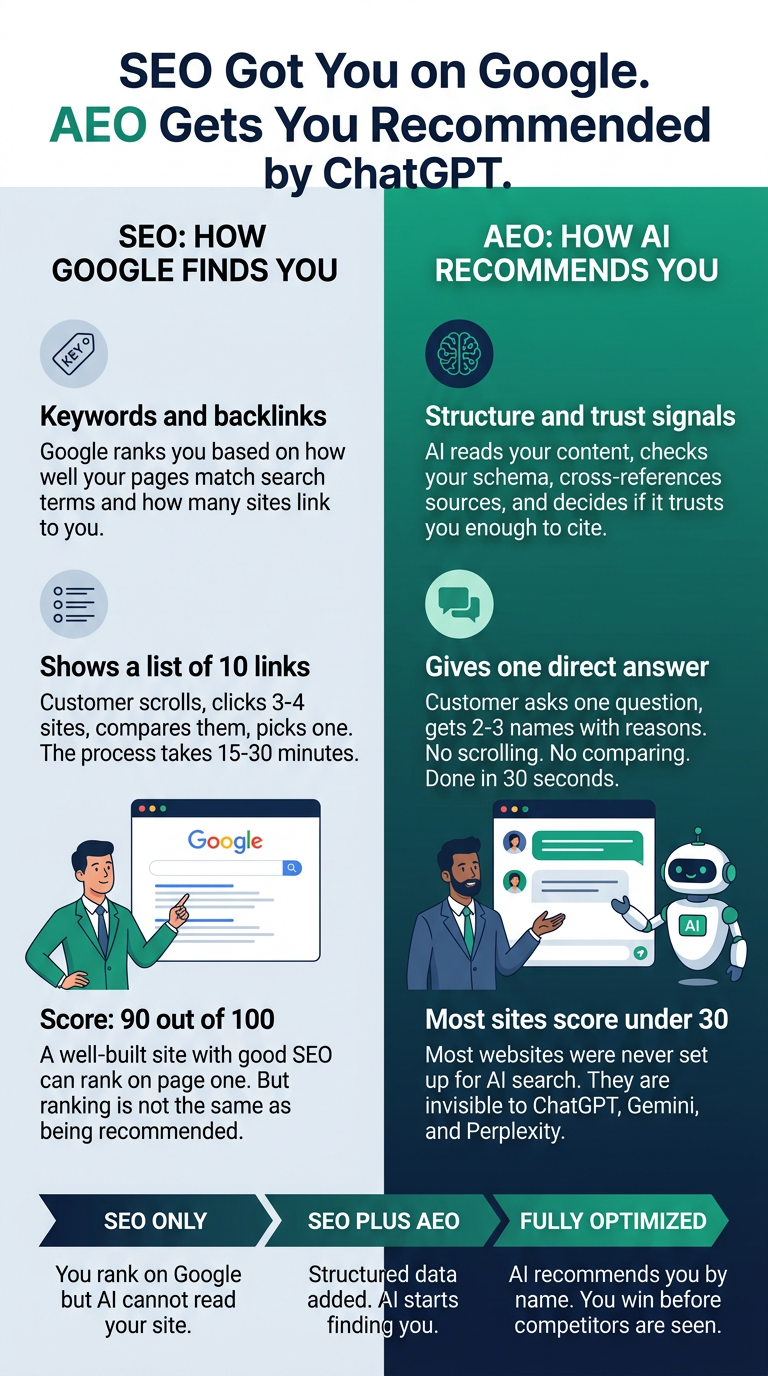
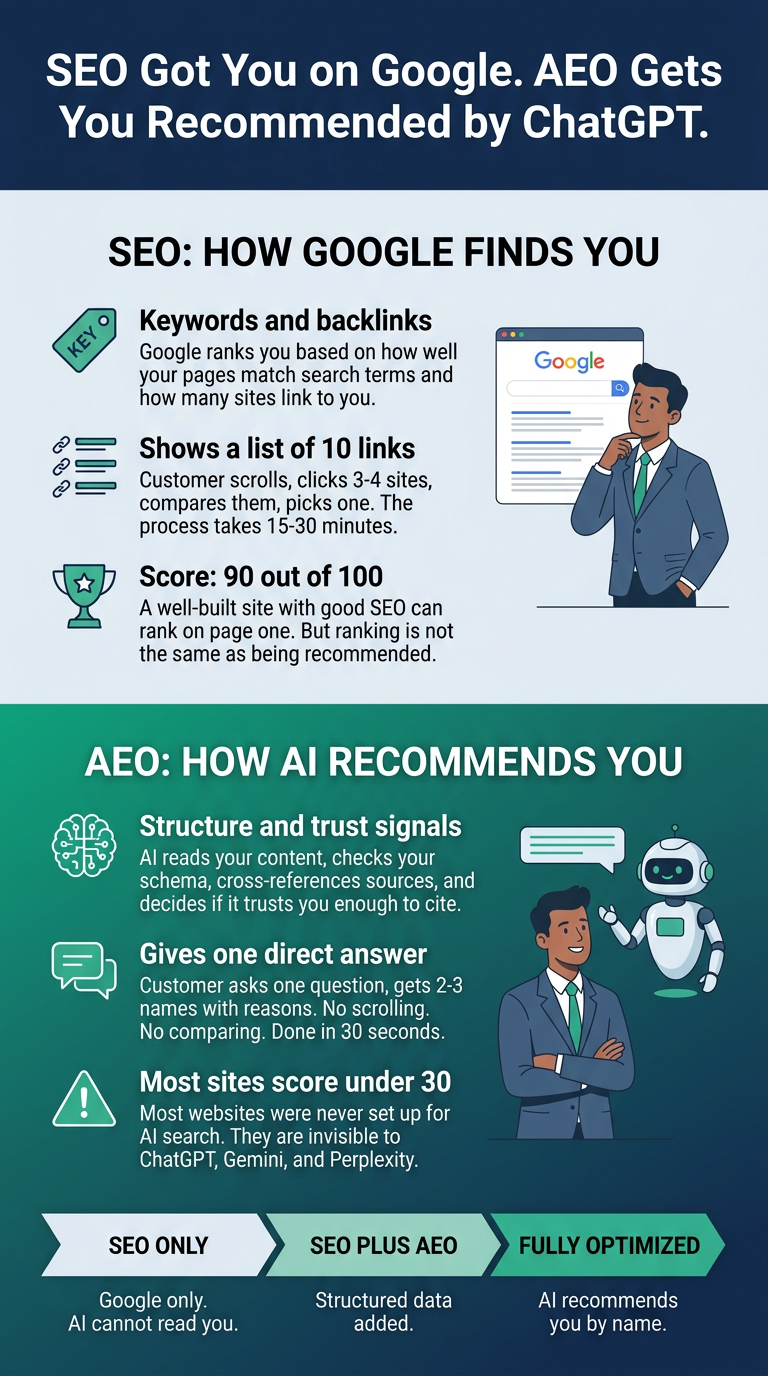
Traditional SEO is about ranking. You optimize your pages so Google surfaces them when someone searches a relevant term. You target keywords, earn backlinks, improve page speed, and write content around what people type into a search bar.
SEO works. Done right, it drives real traffic and real leads.
But when AI answer engines read your site, they are not asking "does this page rank for keywords?" They are asking: who wrote this, what do they do, what problems do they solve, can I trust this source, and is this content structured clearly enough for me to extract an answer from it?
A site can rank well on Google and still score poorly on AI readability. The content might be there. The intent signal might be there. But if the structure is off, if the expertise signals are missing, if there is no schema telling the AI what type of business this is, the AI may simply pass over it when composing a recommendation.
Here is a number that makes this concrete: 80% of the pages cited by ChatGPT and Perplexity do not rank in Google's top 100 results. AEO and SEO are genuinely different games.
What AEO Actually Is
AEO stands for Answer Engine Optimization. It is the practice of making your website understandable, citable, and trustworthy to AI systems that synthesize answers rather than rank pages.
There are four dimensions to it.
Schema markup. This is machine-readable code that tells AI crawlers exactly what your business is: the type of organization, what services you offer, your location, your hours, your reviews. Most small business sites have zero schema. Rich, accurate schema is the foundation. Without it, the AI has to guess what your business does.
Semantic HTML. How your content is structured in the underlying code matters. Proper heading hierarchy. Article and section tags. Clean separation of content from navigation. AI systems parse structured content far more reliably than a wall of text inside a generic div.
AI readability. This is the one most business owners can actually control today without touching code. Does your page have a clear, specific headline that states what you do? Does the first paragraph answer the most likely question a visitor would have? Do you have an FAQ section? AI systems extract answers from pages that are written to answer questions, not just to sell.
Citation worthiness. AI tools cite sources the same way academic papers do. They look for authorship signals, publication dates, supporting data, external links to credible references, and depth of coverage. A page that says "we offer great service and competitive prices" gives an AI nothing to cite. A page that says "here is how this process works, here is why it matters, here is what you should expect" gives it something it can use.
These four dimensions combine into what I call an AEO score: a 0-100 measure of how well a site performs for AI answer engines.
What Most Small Business Sites Score
I built an AEO scoring engine that checks all four dimensions automatically. After running it on a range of sites, the pattern is clear.
The average small business website scores somewhere between 20 and 35 out of 100 on AI visibility.
That is not a judgment on the business itself. It is a reflection of when and how the site was built. Most local business sites were designed with Google's 2015 rulebook. They were never built with AI citation in mind because that was not a thing when they were built.
The good news is that the gap is addressable. And because most of your competitors are in the same position, moving first creates a real advantage. Only 12% of URLs cited by AI assistants rank in Google's top 10 for the same query, which means the businesses winning in AI search are not necessarily the ones winning on Google. It is a separate race, and the starting line is right now.
How does your site score?
Enter your website. Get your AI visibility report by email in minutes.
What Fixing It Actually Looks Like
This is not a one-click fix, but it is also not a rebuild. Most of the work falls into a few practical areas.
Start with your content. Go through your homepage and services pages and ask: if someone landed here knowing nothing about my business, could they understand in 30 seconds what I do, who I do it for, and what makes me credible? If the answer is no, rewrite the key sections. Short paragraphs. Clear headers. Specific descriptions, not generic marketing language.
Add an FAQ section to your most important service pages. AI systems love FAQ content because it is explicitly structured around questions and answers. Write it the way your customers actually ask questions, not the way your marketing materials phrase things.
Add schema markup. This is technical, and if you are not comfortable in code, it is worth getting help. The basics are a LocalBusiness or ProfessionalService schema block with your business type, service area, contact information, and hours.
Check your about page and author signals. If you are a solo operator, make sure your name appears on your site, that there is a real bio that establishes expertise, and that blog posts have bylines. AI citation tools weight authorship heavily.
Build content that answers real questions at depth. Not keyword-stuffed articles. Actual answers to the questions your clients ask most often. A clear, specific page is more citable than a long one that buries the answer in promotional filler.
The Window Is Now
Gartner predicted in February 2024 that traditional search engine volume will drop 25% by 2026, with organic search traffic down 50% or more by 2028. The early data supports that trajectory.
But here is the part most people miss: AI traffic converts better. ChatGPT referral traffic converts at nearly 16%, compared to about 2% for Google organic. The volume is smaller, but the visitors are further along in their decision. They have already had a research conversation with the AI. When they click through, they are ready to act.
The businesses that build AI visibility now will be the ones showing up in those recommendations. Not because of luck. Because they built the right signals early, when their competitors were still ignoring the question entirely.
Your SEO work is not wasted. It still matters. But it is no longer sufficient on its own. The full picture now includes whether AI systems can understand your site, extract answers from it, and confidently recommend you.
Most sites cannot pass that test yet. Yours does not have to be one of them.