
I went looking for a plain-language AEO checklist written for Canadian small business owners. Something a contractor in Hamilton, a bookkeeper in Winnipeg, or a salon owner in London, Ontario could actually use. I searched every combination I could think of.
It does not exist.
Every AEO guide online right now is written for American marketing professionals. They assume you have a marketing team, a content strategy, and a working knowledge of structured data. Most Canadian small businesses have none of those things. Between 35 and 60 percent of Canadian micro-businesses still do not have a website at all.
So I wrote the checklist myself, based on what I actually see when I audit local business websites across Canada. These are the 12 things that determine whether AI tools recommend your business or skip over it entirely.
Why This Matters Right Now
AI Overviews now appear in roughly 30 percent of Google searches. When they show up, organic click-through rates drop by 61 percent. That means even if your site ranks well, fewer people are clicking through because Google is answering the question directly on the page.
At the same time, AI-referred traffic to websites grew 527 percent in just five months in early 2025. ChatGPT alone drives 87 percent of all AI referral traffic. And visitors who arrive through AI recommendations convert at 11 times the rate of traditional search visitors.
The shift is not coming. It already happened. The businesses that show up in AI answers are getting higher-quality leads. The ones that do not are watching their phone get quieter without understanding why.
Only 12.2 percent of Canadian businesses are using AI in any capacity, according to Statistics Canada. Two-thirds say they have no plans to start. That means the window to get ahead of your local competition is wide open. It will not stay that way.
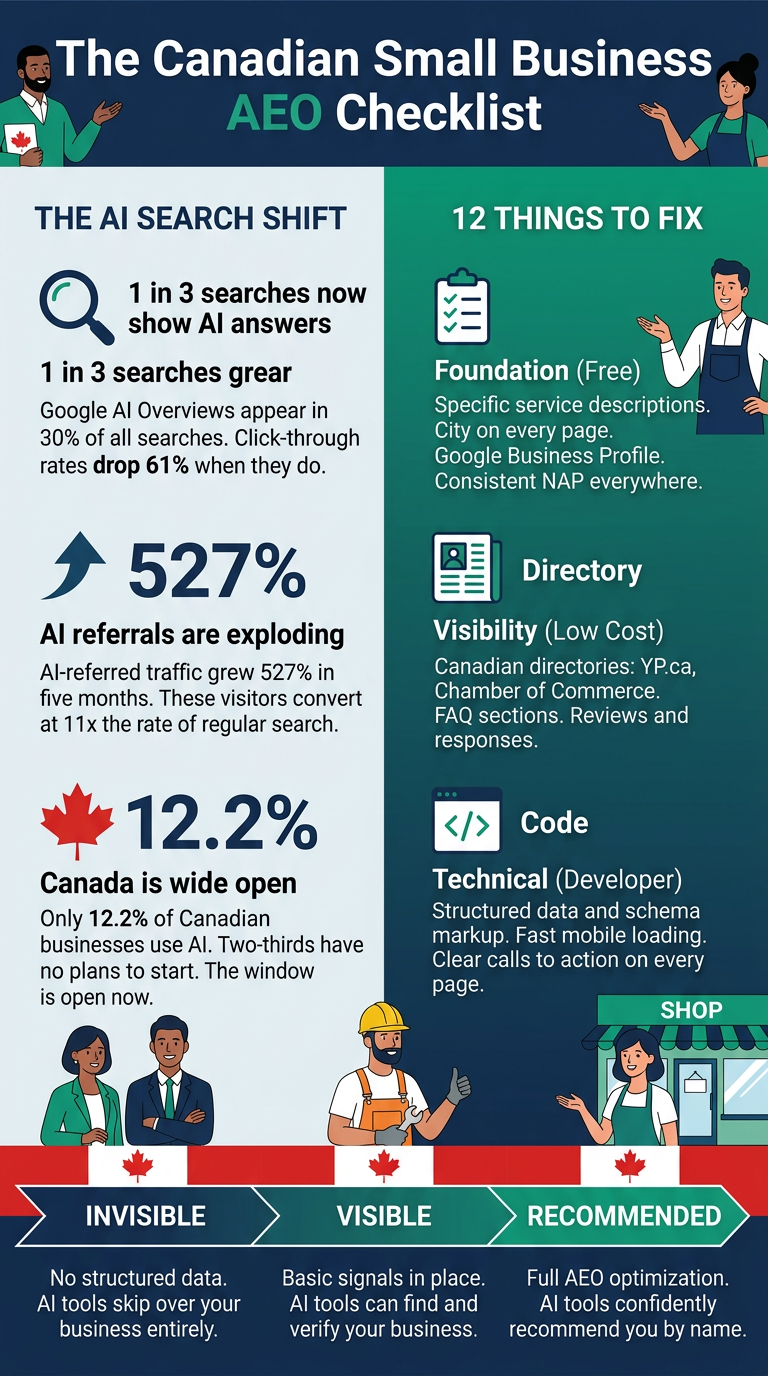
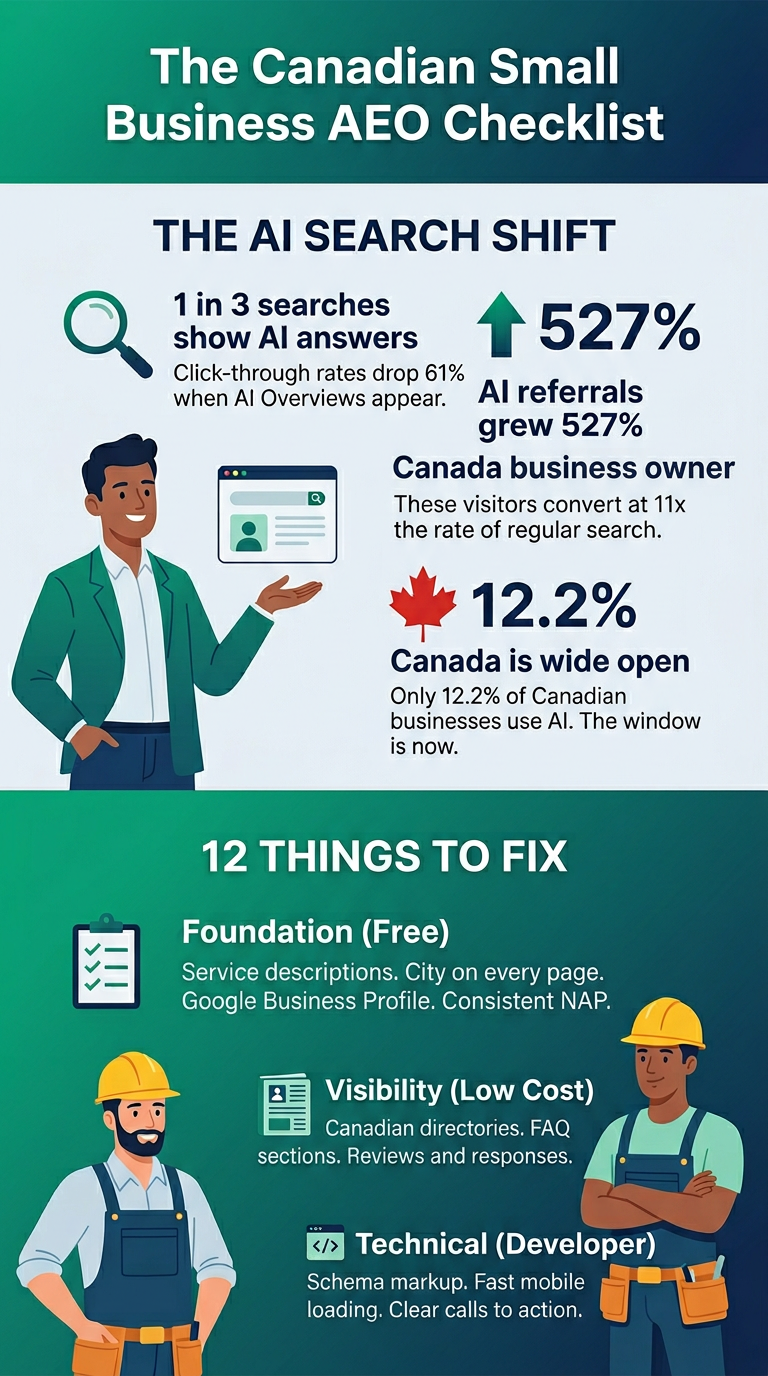
The Checklist
1. Write Specific Service Descriptions
If your website says "we offer a full range of services" without listing exactly what those services are, AI tools cannot categorize you. They need specifics. Instead of "home renovation services," write "kitchen renovations, bathroom remodels, basement finishing, and custom cabinetry in London, Ontario." The more precise, the more likely an AI will match you to a specific question.
2. Put Your City and Province on Every Service Page
AI tools need geographic signals to recommend local businesses. Your homepage might mention your city once, but if your individual service pages do not, the AI has no way to connect your plumbing service to your location. Add your city and province naturally to page titles, headings, and body text on every page that describes what you do.
3. Complete Your Google Business Profile
A verified, complete Google Business Profile is one of the strongest trust signals for AI tools. Fill in every field. Add your hours, your service area, your business category, and a description that matches your website. Upload recent photos. Businesses with complete profiles are significantly more visible to AI tools that cross-reference Google data when building recommendations.
4. Make Your NAP Identical Everywhere
NAP stands for Name, Address, and Phone number. If your phone number on Google is different from the one on your website, or your business name is spelled slightly differently on Yelp.ca, that inconsistency is a red flag. AI tools treat consistency as a trust signal. Pick one exact format and use it everywhere: your site, your Google profile, your directory listings, your social media.
5. Get Listed on Canadian Directories
Most guides tell you to get listed on Yelp and the Better Business Bureau. That advice is incomplete for Canadian businesses. You should also be on Yellow Pages Canada (YP.ca), your local Chamber of Commerce directory, the Canadian Business Directory, and any industry-specific Canadian listings that apply to your trade. Each listing that matches your NAP strengthens the signal that your business is real, established, and operating where you say you are.
6. Add FAQ Sections to Your Main Pages
AI tools are built to answer questions. If your website has a section that directly answers the questions your customers ask before hiring you, the AI has source material to pull from. "How long does a kitchen renovation take in Ontario?" "Do you offer free estimates?" "What areas do you serve?" Write the questions your customers actually ask, not the ones you wish they would ask. Use the real language real people use.
7. Add Structured Data to Your Website
Structured data is invisible code that tells AI tools exactly what your business is. It includes your business type, location, services, reviews, and operating hours in a format machines can read directly. Most small business websites have none of it. Adding LocalBusiness schema, FAQ schema, and Service schema gives AI tools structured facts to work with instead of forcing them to guess from your page content. If this sounds technical, it is. But a developer or your web provider can add it in an afternoon.
8. Publish Content That Answers Real Questions
Blog posts, guides, and articles that answer specific questions perform well in both traditional search and AI recommendations. "How much does a new furnace cost in Ontario?" is a better topic than "Why choose us for HVAC." The first one answers a question someone is actually asking. The second one is a sales pitch. AI tools recommend answers, not pitches.
9. Earn and Respond to Reviews
Reviews are a major trust signal for AI tools. Businesses with more recent, positive reviews are more likely to be recommended. But volume alone is not enough. Responding to reviews, both positive and negative, signals that the business is active and engaged. Ask satisfied customers to leave a review on Google. Then respond to every one, even if it is just a brief thank you.
10. Build a Real About Page
AI tools evaluate expertise signals. An About page that includes the owner's name, qualifications, years of experience, certifications, and professional affiliations gives AI tools reasons to consider you credible. "Family-owned since 2005" is good. "Licensed and insured plumber with 18 years of residential experience in Southwestern Ontario, member of the Ontario College of Trades" is better. The more specific and verifiable, the stronger the signal.
11. Make Your Site Fast on Mobile
Over 60 percent of local searches happen on phones. If your site takes more than three seconds to load on a mobile connection, visitors leave before they even see what you offer. AI tools also factor page experience into their assessments. A slow, cluttered site signals poor quality regardless of how good the content is. Test your site at PageSpeed Insights and aim for a mobile score above 80.
12. Put One Clear Call to Action on Every Page
Every page on your site should make it obvious what someone should do next. Call this number. Fill out this form. Book a consultation. If a visitor has to hunt for how to contact you, they will leave. And if an AI tool cannot identify a clear action path on your site, it is less likely to recommend you as a business someone can easily engage with.
How to Use This Checklist
You do not need to fix all 12 items at once. Start with the ones that are completely missing. Most businesses I audit are missing at least six of these. The ones that score lowest are almost always missing items 1, 5, 6, and 7: specific service descriptions, Canadian directory listings, FAQ content, and structured data.
If you fix those four things, you will be ahead of the majority of your local competitors before they even know this shift is happening.
Where Canadian Businesses Stand
Statistics Canada reports that 66.7 percent of Canadian businesses have no plans to use AI in the next 12 months. The top reason given by 78 percent of them is that AI is "not relevant" to their business.
That is not a technology problem. That is an awareness problem. AI tools are already recommending businesses in every category, in every Canadian city. The question is not whether AI is relevant to your industry. The question is whether your business is visible to the tools that are already shaping how customers find and choose local providers.
The gap is still small enough to close. But every month that passes, the businesses that are optimized pull further ahead and the ones that are not become harder to find.
Find Out Where You Stand
If you want to know how your business scores on these 12 items, I offer a free AI visibility scan. You get a real score, a breakdown of what is working and what is missing, and a clear explanation of what it would take to improve. No obligation, no pitch. Just an honest look at where you stand compared to your local competition.