
Your business shows up on Google. You have a website. Maybe you have a few good reviews. You've done the work. So when someone in London types "best [your service] near me," you come up. That's real. That matters.
But something changed in the last two years, and most business owners haven't caught it yet. 56% of Canadian consumers have already used ChatGPT, and 51% say they are likely to use AI tools to research purchases. That number jumped 10 points in a single year.
More and more people aren't searching anymore. They're asking. They open ChatGPT, Perplexity, or Google's built-in AI and type a question: "Who should I hire to redo my bathroom in London, Ontario?" or "What's a good bookkeeper for a small business in the area?" And they get a direct answer. A recommendation. A short list with names and reasons.
Your Google ranking does not determine whether your name is in that answer.
The Shift Nobody Warned You About
ChatGPT now has over 800 million users, and Google AI Overviews reach 1.5 billion monthly users. These are not experimental features anymore. They are where attention goes first. And ChatGPT referral traffic to websites grew 206% in 2025 alone.
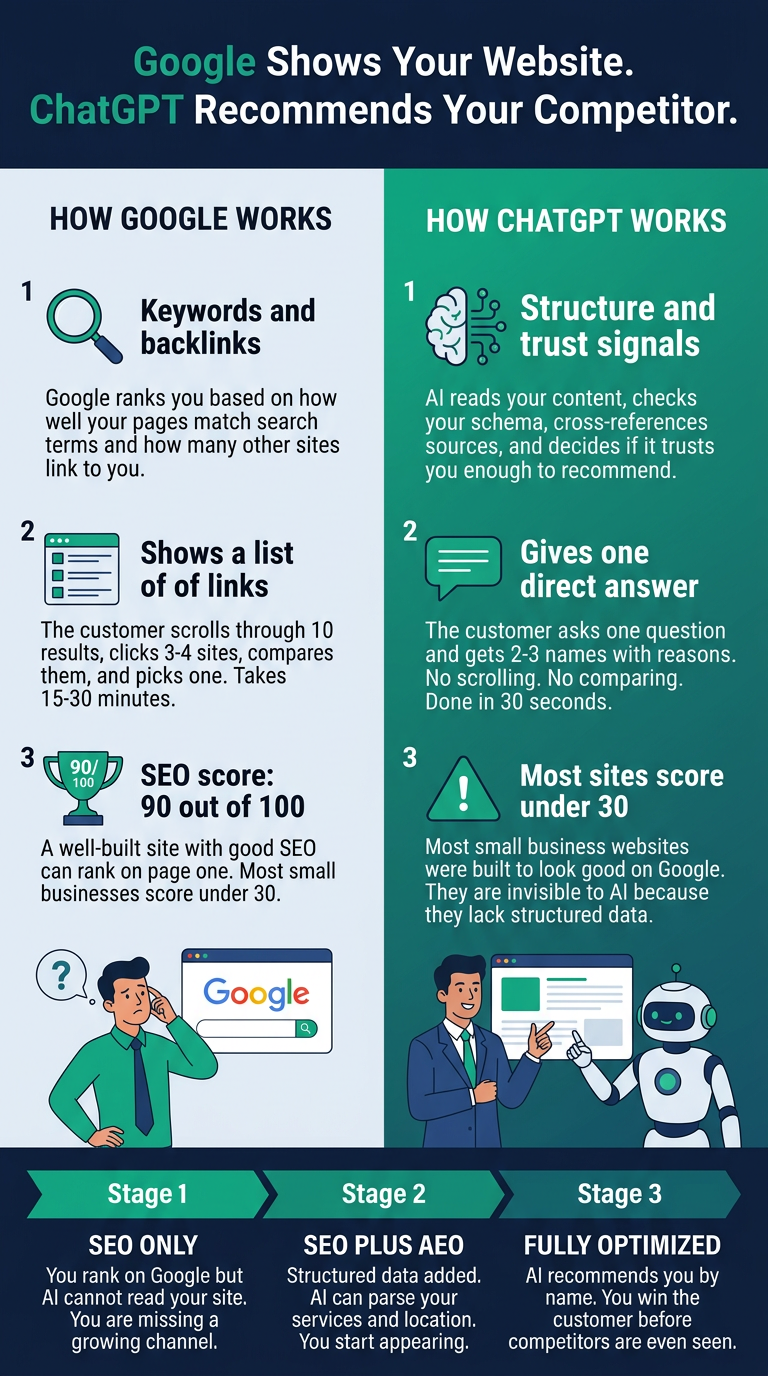
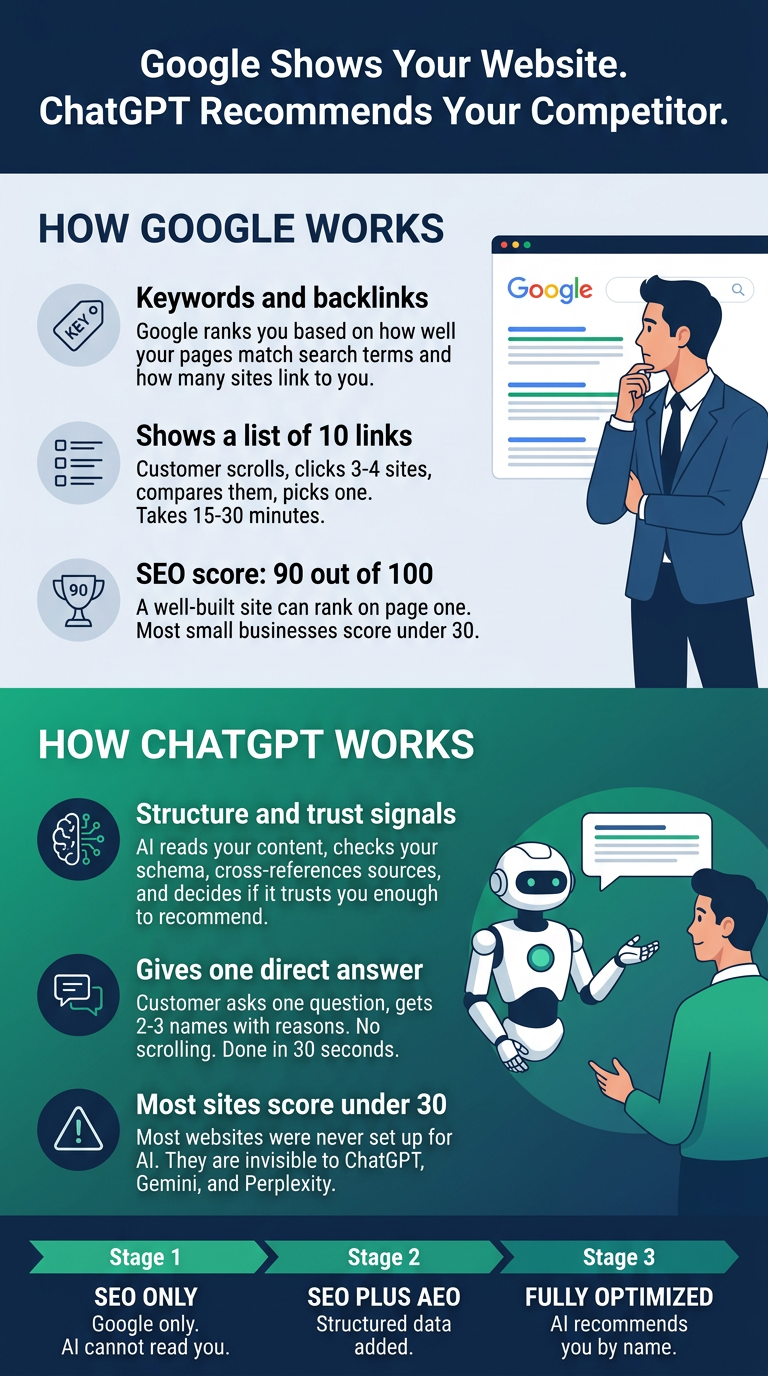
The old path looked like this: a person searches, gets a list of links, scrolls through, picks a few to click, and eventually makes a decision. That process gave every business a fair shot based on how well their website was built for search engines.
The new path is shorter: a person asks a question, gets a direct answer with specific names, and calls the first one that sounds right. And roughly 93% of AI search sessions end without the user ever visiting a website. If you are not in the AI's answer, there is no second chance.
If the AI doesn't know your business well enough to recommend it confidently, you're not in that answer. Doesn't matter how long you've been in business. Doesn't matter how many five-star reviews you have. The AI gives people what it can verify, summarize, and present clearly.
Why Google Ranking Isn't Enough Anymore
Google search rankings are based largely on how many other sites link to you, how well your pages match keywords, and how technically clean your site is. These are signals built for a system that shows links.
AI tools don't show links the same way. They read your content, pull information from it, cross-reference it with other sources, and decide whether they trust it enough to cite it in a recommendation.
The businesses that get recommended are the ones that give AI clear, structured, trustworthy information to work with. That means things like: organized descriptions of exactly what services you offer, consistent information across your website and other platforms, content that directly answers the questions your customers ask, and technical signals built into your site that help AI understand what your business does, who it serves, and where it operates.
Most small business websites don't have any of this. They were built to look good and rank on Google. That was the right call five years ago. It's incomplete now.
What "AI-Recommendable" Actually Means
You don't need to become a tech expert to fix this. But it helps to understand what's actually happening.
When an AI tool gets asked "who should I hire for X in London, Ontario," it scans everything it can find about local businesses in that category. It's looking for signals that a business is real, established, and trustworthy. A few things that matter:
Clear service descriptions. If your website says "we do it all" but never clearly states what "it all" includes, an AI can't confidently categorize you. A page that says "I build custom websites for restaurants and service businesses in London, Ontario" gives it something concrete to work with.
Structured information. There's a layer of code that can be added to any website, invisible to visitors but readable by AI tools, that tells them exactly what your business is, what you offer, where you're located, and what makes you credible. Most sites don't have it. The ones that do get an advantage.
Questions and answers. AI tools are built to answer questions. If your website has a section that answers the specific questions your customers ask before hiring you, an AI is more likely to pull from it. "How long does a website build take?" "Do you work with businesses outside London?" "What's included in your monthly plan?" Those answers, written on your site, become source material.
Consistent, authoritative information. If your phone number is different on Google, your website, and a local directory, that inconsistency is a red flag. AI tools weight consistency as a trust signal. Clean up the basics and you're ahead of most local competitors.
None of this is complicated. But it requires someone to actually do it, and most website owners don't know it's necessary.
This Isn't Replacing SEO
One thing I want to be clear about: SEO is not dead. Google search still drives enormous traffic. You should absolutely keep caring about your rankings.
AEO, or Answer Engine Optimization, is a layer on top of SEO. It's the work of making sure that when AI tools are figuring out who to recommend, your business has the information structure to be considered. Most of the work overlaps with good SEO practice. A well-organized site with clear content helps both.
The difference is in the specifics. Google rewards keyword density and backlinks. AI tools reward clarity, structure, and trust signals. Doing both is not dramatically harder than doing one. But you have to know what you're doing and why.
A Real Number to Put This in Context
I ran MapleLink Services through a full AEO audit earlier this year. The score came back at 90 out of 100. That's after deliberately building the site to meet these standards.
When I run the same audit on typical small business websites in the area, most score under 30. Some score under 10. It's not because those businesses are bad at what they do. It's because their websites were never set up for this, and nobody told them it existed.
A 30 out of 100 doesn't mean you're invisible on Google. It means that when an AI tool is deciding who to recommend in your category, you're at a structural disadvantage before any other factor is considered.
How does your site score?
Enter your website. Get your AI visibility report by email in minutes.
What to Do Next
If you're curious where you stand, I offer a free AEO scan for local businesses. You get a real score, a breakdown of what's working and what isn't, and a clear explanation of what it would take to improve.
No sales pitch attached. If the scan comes back strong, I'll tell you. If there are gaps worth fixing, you'll know exactly what they are and what it would cost to address them.
Right now, only 24% of consumers prefer AI chat for local business queries because the tools do not integrate well with maps yet. That number is climbing. The businesses that get this right now, while the competition is still figuring it out, will have a quiet advantage that compounds over time. The ones that ignore it will watch competitors get recommended while they wonder why their phone got quieter.
Get your free AI visibility scan at maplelinkservices.ca/aeo.