
Most business owners I talk to have done one of two things with AI: nothing, or a lot of experimenting that led nowhere useful.
The numbers confirm this. Only 12.2% of Canadian businesses have formally adopted AI, and 78.1% of those not planning to adopt say AI is simply "not relevant" to their business. That is not a technology problem. That is a framing problem.
The reason this keeps happening is a framing problem. Most people approach AI as a single thing, a piece of software that does stuff. But there are actually three distinct ways AI can work in your business, and they are not interchangeable. Each one requires something different from you. Each one solves a different kind of problem. And if you pick the wrong one to start with, you will waste months trying to adopt something your business was never set up for.
Here is how to tell them apart.
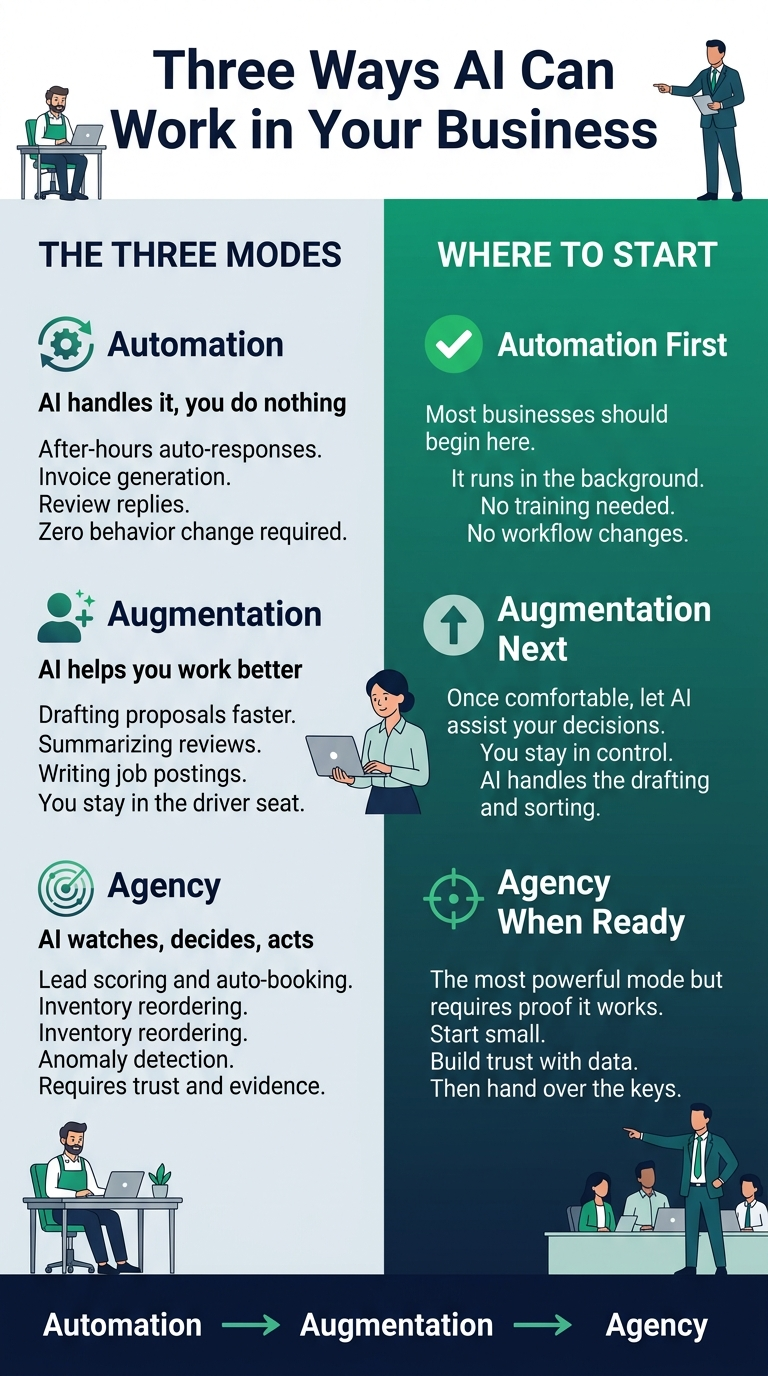
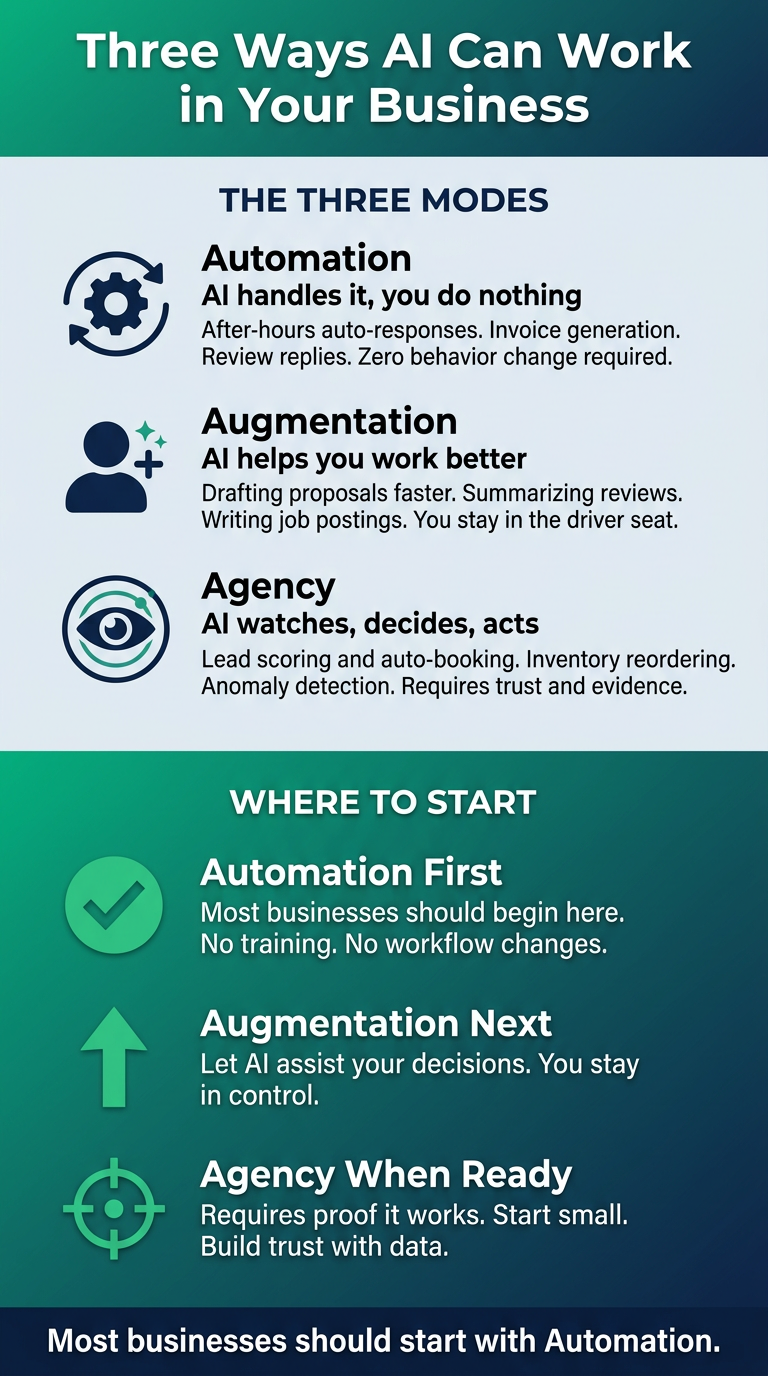
Mode 1: Automation (AI handles it, you do nothing)
Automation means the task runs without you. You are not in the loop. You do not review it. You do not approve it. It just happens.
Examples: A client submits an intake form at 11 PM. By 11:01, they have a personalized confirmation in their inbox. A new invoice gets created the moment a customer fills out a booking request. Your Google Business listing gets a new review. An AI-drafted response goes up within the hour. Every Monday morning, your team gets a summary of the previous week's open tasks, pulled from your project tool.
Notice what these have in common. The trigger is clear, the response is predictable, and the cost of an occasional imperfect output is low. No one is harmed if the automated reply is slightly generic. No deal is lost if the task summary misses a nuance.
This is the mode most Canadian small businesses should start with. Not because the others are bad, but because Automation requires zero behavior change on your end. You do not need to learn a new tool. You do not need to build a new habit. You identify a task that runs the same way every time, and you stop doing it manually. The time you were spending comes back to you every single week.
The data supports this. Canadian SMEs using generative AI report gaining more than twice the time they invest: 2.05 hours gained for every 0.97 hours spent. And for every $1 invested in digital tools including AI, Canadian small businesses saw $1.60 in return. Businesses that fully integrated these tools saw $2.40 back per dollar.
I have written more about the real cost of not automating in What Automation Actually Costs a Canadian Business in 2026, if you want numbers behind the argument.
Mode 2: Augmentation (AI helps you do your work better)
Augmentation means you are still doing the task. AI makes you faster or sharper while you do it.
Examples: You are writing a proposal for a new client. You paste your notes into an AI tool, and it drafts the first version. You rewrite what does not sound right and send it in half the time. You have 60 customer reviews to read before a team meeting. You ask an AI tool to summarize the common complaints. You walk into the meeting having read the pattern, not every individual review. You are hiring for a front desk position. You describe what you need, and the AI drafts a job posting. You adjust the tone and post it. You are preparing for a tricky client conversation. You describe the situation to an AI tool, and it helps you anticipate objections.
Augmentation does require a behavior change. You have to build the habit of reaching for an AI tool instead of grinding through the task alone. That sounds minor, but it is a real adjustment, and some people never make it. They try the tool once, get an output that is 70% right, correct the 30%, and decide it was not worth it. They missed the point. The value is the 70% that showed up instantly, not the 30% that needed editing.
If your team is already using AI tools this way, even informally, they are in Augmentation mode. If you want to understand whether they know more about this than you do, the Employee Who Knows AI post is worth a read.
Mode 3: Agency (AI watches, decides, and acts on your behalf)
Agency is the most powerful mode and the most demanding to set up correctly.
In Agency mode, an AI system monitors something, makes a judgment call, and takes action without waiting for you to notice the situation first.
Examples: A lead fills out your contact form. An AI system scores the lead, determines it is high quality, sends a personalized response, and books a call on your calendar, all before you have seen the inquiry. Your inventory system detects a product dropping below a reorder threshold and places the order automatically. Your financial dashboard flags an unusual expense pattern at 7 AM and sends you a message before your day starts. A support request comes in that your AI system cannot resolve. It escalates to a human and includes a summary of the issue, saving the human from having to read the full thread.
The difference between Agency and Automation is judgment. Automation follows a fixed script. Agency operates within defined boundaries but makes decisions inside those boundaries. A well-built Agency system is one of the most powerful operational advantages a small business can have. It gives you coverage you could not afford to staff.
The tradeoff is that Agency requires trust, and trust requires evidence. You build evidence by starting small, watching the system make correct decisions over time, and gradually expanding its scope. Rushing this step is how businesses end up with AI systems that do the wrong thing confidently.
How to Figure Out Which Mode You Need
Start with one question: does this task follow a predictable pattern?
If yes, it is a candidate for Automation. No behavior change required. Just stop doing it manually.
If the task requires judgment, your judgment, and the output benefits from your expertise or context, that is Augmentation territory. You are not removing yourself from the task. You are getting a head start.
If the task requires ongoing monitoring and time-sensitive action, and you cannot realistically be available every time the trigger fires, that is where Agency becomes worth the setup cost.
Most businesses have all three types of tasks sitting in their operations right now. Yet only 23% of Canadian SMEs have invested in generative AI over the past three years, and 52% report no plans to invest at all. The ones that are stuck tend to try Agency first because it sounds the most impressive, hit friction, and give up. The ones that move fast start with Automation, get some quick wins, build confidence, and expand from there.
The honest reality is that AI is not a replacement for thinking about your business clearly. If your processes are poorly defined, automating them will produce consistently poor output faster. The first step is always understanding what you are actually doing, not just what you want to hand off.
What Comes Next
If you have read this far and you are thinking about which tasks in your business belong in which category, that is exactly the exercise a Process Audit is designed to work through.
I map your workflows, identify the repetitive and predictable tasks that are immediate Automation candidates, flag the places where Augmentation would make your team faster, and point out where Agency mode could give you coverage you currently do not have.
The output is a clear priority list, not a general recommendation to explore AI. You walk away knowing what to build first and why.