
A business owner needed a contract split into smaller agreements. His employee said "just use ChatGPT." The owner said "use what?" The employee opened a tool on his phone, typed a few sentences, and had the contract rewritten in under a minute. Clean, structured, ready to review.
The employee had been using it for months. The owner had no idea it existed.
This Is Not an Isolated Story
That HVAC company is not unusual. Across industries, employees are quietly using AI tools at work. They draft emails with them, research competitors, generate reports, summarize documents, and solve problems that used to take hours. Most of them never mention it to their boss.
The reason is simple. They assume their boss either would not understand or would not approve. The data backs this up: 52% of employees who use AI at work are reluctant to admit using it for their most important tasks. And 78% of AI users bring their own tools to work, bypassing anything their employer provides or approves. At small and medium companies, that number is 80%.
Meanwhile, organizations across North America are adopting AI without clear strategies. Millions of people use these tools daily at school, at work, and at home. The technology moved from experimental to mainstream in less than two years. But most business owners missed the shift because nobody sat them down and explained what changed.
Here is the part that matters. Only 12.2% of Canadian businesses have formally adopted AI, up from 6.1% the year before. That is doubling, but from a very low base. And only 23% of Canadian SMEs have invested in generative AI over the past three years. The risk is not that AI will replace you. The risk is that you become the last person in your own company to understand what is already happening around you.
This Is Not a Tech Problem
If you have read this far, you might be expecting a technical explanation. How AI works, what algorithms do, which tools to download. That is not what this is about.
AI fluency is not a technical skill. It is a leadership skill.
It means understanding what these tools can do for your business. Knowing when to use them and when not to. Making decisions about AI with confidence instead of confusion. 79% of business leaders agree AI adoption is critical to remain competitive, yet 60% say their company lacks a plan to implement it. You do not need to know how a combustion engine works to decide which truck to buy for your fleet. You need to know what it can carry, how far it goes on a tank, and whether it fits the job. The same logic applies here.
The gap most owners face is not a lack of intelligence or technical ability. It is a gap between what is now possible and what still feels unfamiliar. That gap closes faster than you think, but only if you decide to close it.
What AI Fluency Actually Looks Like
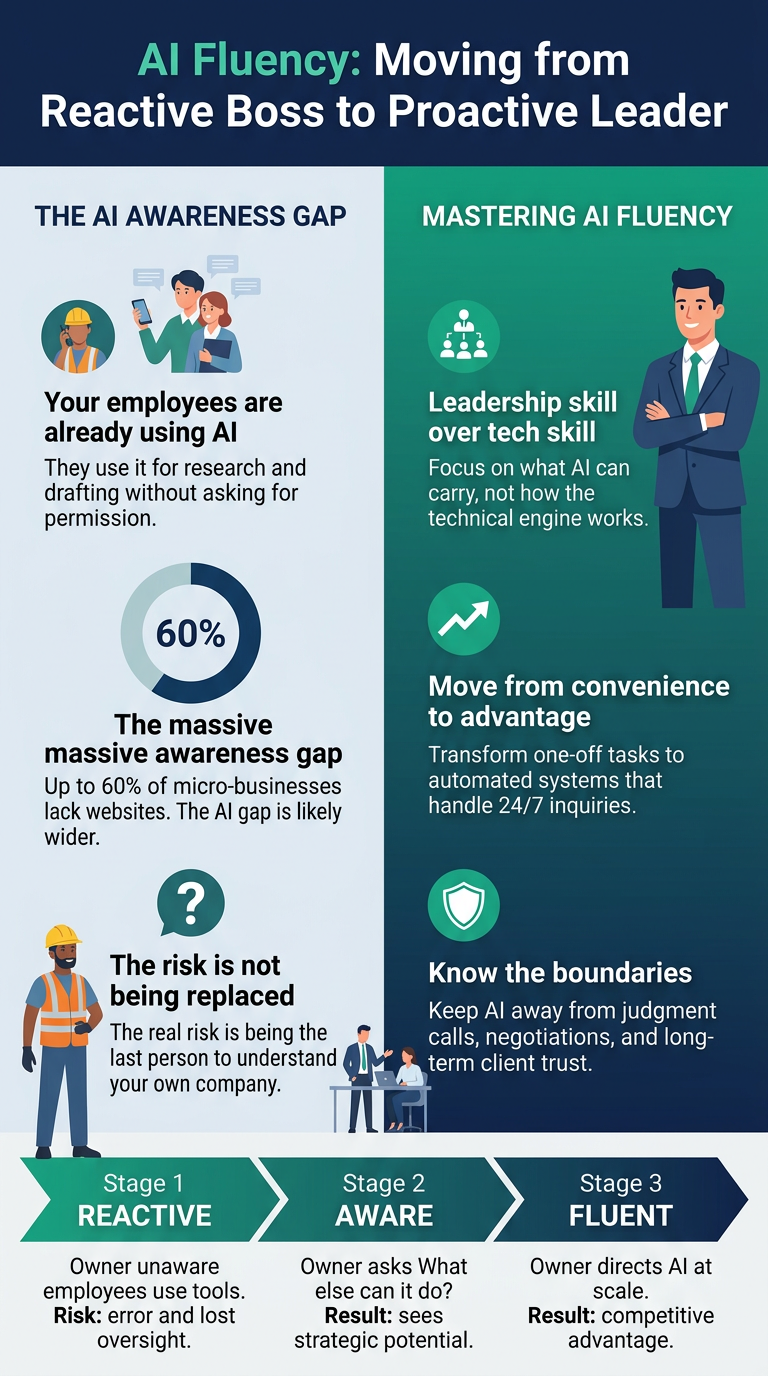
Forget the buzzwords. Here is what it looks like when a business owner understands AI well enough to lead on it.
Knowing what to hand off. Your employee uses AI to draft follow-up emails. That is useful. But a fluent owner sees the bigger picture. The same capability that drafts one email can handle every inquiry that comes in after you close for the day. Automatically. No missed leads at 10 PM. No lost customers over the weekend. The difference between an employee using AI and an owner directing AI is the difference between convenience and competitive advantage.
Knowing what questions to ask. You do not need to build AI systems. But when someone offers you an AI-powered service, you need to know what to ask. "What happens when it gets something wrong?" is a better question than "how much does it cost?" A fluent owner evaluates AI the same way they evaluate a new hire: what can you do, where are your limits, and how do I verify your work?
Knowing where the boundary is. AI cannot make a judgment call about your most important client. It cannot read the room during a negotiation. It cannot build the trust that keeps a customer loyal for a decade. Knowing what AI should never touch is just as valuable as knowing what it handles well. The owners who get burned are the ones who hand off something they should not have, because nobody told them where the line was.
Back to the HVAC Company
After the contract was done, the owner was not angry. He was not threatened. He was quiet for a moment. Then he asked the question that changes everything.
"What else can it do?"
That is the moment. Not the moment he became an expert. Not the moment he signed up for a course or downloaded an app. The moment he decided to pay attention. Everything after that is just details.
The gap between "I have never heard of this" and "I understand enough to make decisions" is smaller than most people think. It does not take months. It takes one honest conversation about what is possible and what is not.
The Real Question
Your employees are already using AI. Some of them are using it well. Some of them are using it poorly. Either way, they are using it, and they are not waiting for your permission.
The question is not whether AI is relevant to your business. That question was answered months ago by the people who work for you. The real question is whether you are going to lead on it or react to it. Those are two very different positions, and the gap between them grows wider every month.
What to Do Next
If you are not sure where AI fits in your business, or whether it fits at all, I can help you figure that out. No pitch, no package, no obligation. Just a conversation about what is actually possible for your specific situation, based on what I see working for businesses like yours every day.
Book a free consultation at maplelinkservices.ca.